












































×

iFour Logo

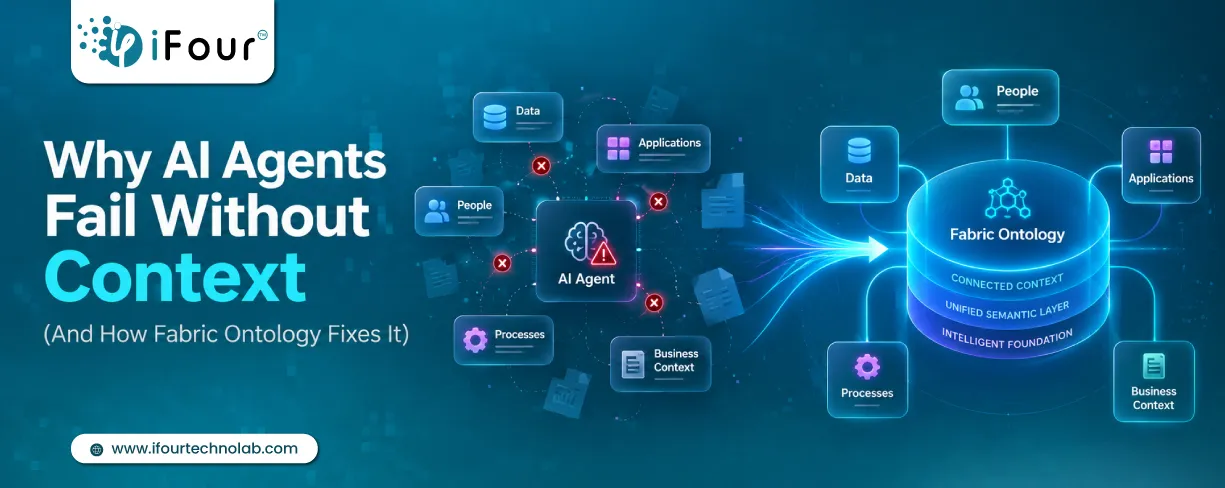
Why AI Agents Fail Without Context (And How Fabric Ontology Fixes It)

Kapil Panchal October 05, 2026

Listening is fun too.

Straighten your back and cherish with coffee - PLAY !
  • play
  • pause
  • pause

Summarize this article with:

Why AI Agents Fail Without Context (And How Fabric Ontology Fixes It)

Quick Summary:

  • AI agents don't fail because they lack intelligence. They fail because they lack business context. Enterprise data often contains information but not meaning.

  • Fabric Ontology addresses this challenge by connecting data, business definitions, relationships, and semantics, helping AI agents understand how information relates across an organization.

  • Note: Fabric Ontology makes AI responses more reliable, but human review is still needed for governance.


Enterprise AI agents are getting smarter every day. They can search data. Read documents. Call APIs. Use tools. Even complete multistep workflows on their own.

Despite this, why do 90% of AI agents fail?

Because Access to data DOESN'T mean understanding the business.

The problem isn't capability. It's context.

Now imagine this:

Two AI agents have access to the same enterprise systems.

  • One understands how business concepts, relationships, and rules connect.
  • One doesn't.

The first AI Copilot gives you answers that are consistent, explainable, and aligned with business reality.

The second agent?

It pulls information from disconnected sources, interprets concepts differently across systems, and sometimes returns answers nobody can confidently trust.

That's the difference business context makes.

Without a business context, even the most advanced AI agent can produce wrong and inconsistent answers.

That's why organizations like iFour are turning to Microsoft Fabric Ontology to give AI agents a shared understanding of the business behind the data.
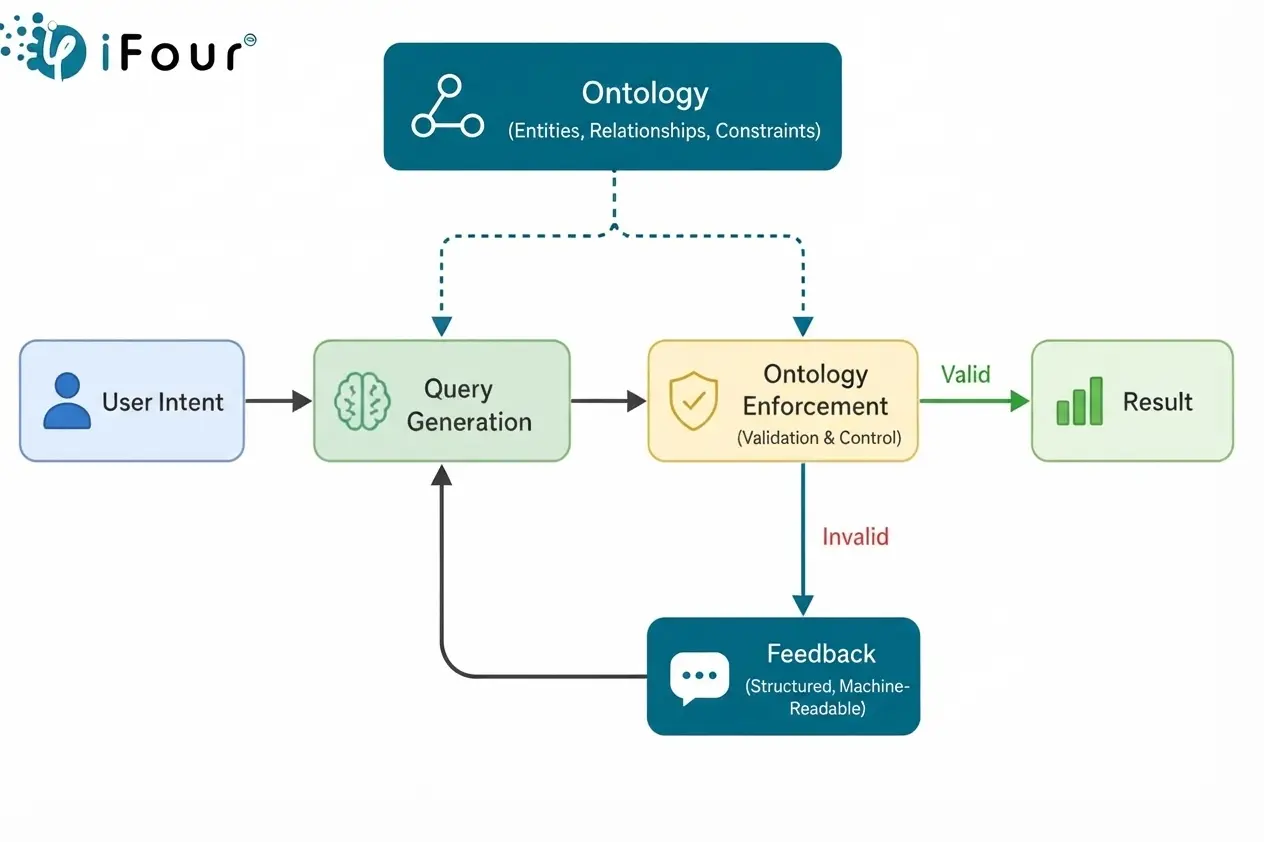
Microsoft Ontology process

Image: The key components of ontology-driven agents

What is Fabric Ontology?

  • It is a semantic framework from Microsoft that allows AI systems to understand business entities, relationships, metadata, and domain-specific meanings across enterprise data.

  • Microsoft Fabric Ontology is a part of Fabric IQ, and it provides a machine-understandable representation of business concepts, such as products and customers, creating a shared vocabulary that AI assistants and Autonomous systems understand.

  • Accuracy note: Fabric Ontology can improve grounding, consistency, and explainability, but it does not guarantee correct outputs or eliminate hallucinations.


What Does Context Mean for an Agent?

Context is the business information that helps AI understand data correctly and make better decisions. It includes business rules, relationships, permissions, ownership, and other details that give meaning to raw data.

For example, a customer generating $1.2 million in revenue is just a number. To understand what it means, AI may also need to know:

  • Which revenue calculation is being used
  • The time period covered
  • Whether the customer account is active
  • Related contracts and agreements
  • Upcoming renewals
  • Which business unit owns the account
  • Whether the user has access to the underlying data

An ontology provides this missing context. It organizes business entities, relationships, rules, and data connections into a shared structure that AI can understand.

This helps AI deliver more accurate, consistent, and business-aware insights.

Want to make your data AI-ready? Explore our Fabric Ontology development services that connect your data, business knowledge, and AI goals.
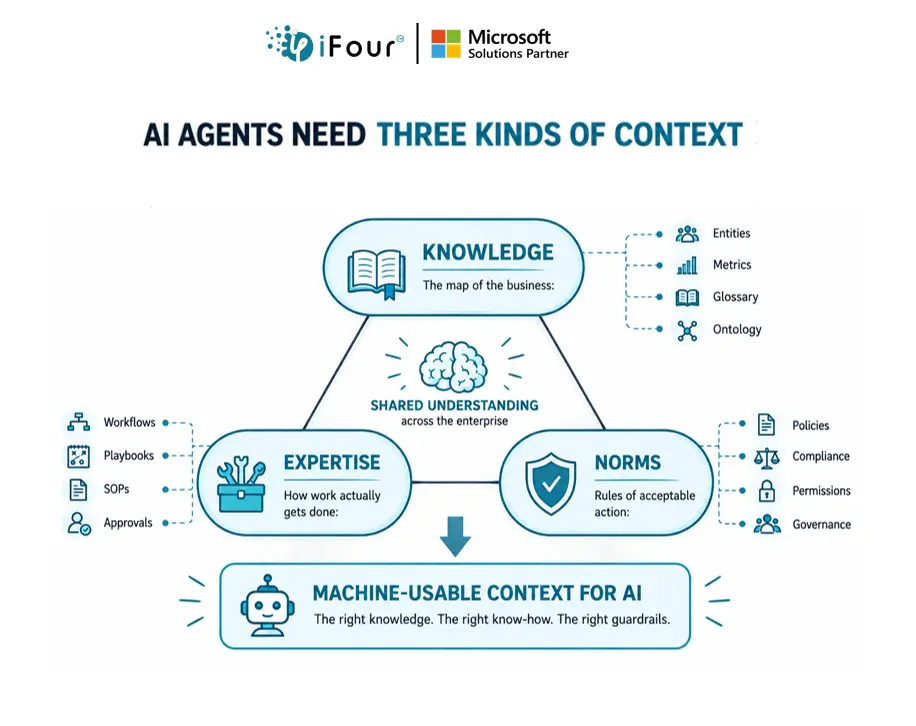
Context Mean for an Agent

Why AI Agents Fail Without Context?

According to the 2025 Fortune report, 95% of companies faced enterprise AI failure due to learning gaps. The problem is not in model quality; the problem is a lack of context.

AI agents struggle when they cannot understand business relationships, organizational structures, data lineage, or domain-specific definitions.

That's where Fabric Ontology comes in to fill this gap by acting as a business context and semantic modeling layer.

Enterprises, including Fortune 500s and SMEs, are investing heavily in intelligent systems to improve employee productivity, automate customer support, accelerate business operations, and accelerate AI-powered decision-making.

The expectation is simple:

But in reality, here's what they discover with autonomous systems:

  • Conflicting responses
  • Missing critical business nuances
  • Inaccurate recommendations
  • Enterprise-specific terminology problems
  • Hallucinated information that sounds believable but isn't correct

The issue usually isn't data access. The issue is context.

Explore the full guide - AI Agents fail due to lack of context.

Key Reasons AI Agents Fail

AI doesn't fail because it's not intelligent enough. It fails when it lacks quality data, business context, governance, and human oversight. Let's walk through the major reasons why 80% of enterprise AI projects fail.

1. AI fails due to hallucinations

Since the emergence of AI systems, everyone has started leaning towards AI for workflows, but the critical thing most people do is rely on AI answers blindly.

AI is great at speed. But when AI doesn't get access to the right data, it starts producing hallucinated information, which could include:

  • Fabricated answers
  • Missing validation
  • Wrong assumptions, etc.

Since it is well-structured and confident, you feel the content is 100% correct. That's the problem.

How does Ontology solve AI hallucinations?
By giving AI the right business context, reducing wrong or made-up answers.

Explore this to see what the context layer is and why it's become the most urgent problem in enterprise AI.

Actionable solutions

Outdated tools slowing your firm?

Upgrade fast with our Legal Software Development services

2. Misinterpreting business language causes AI failure

A common word in business could have different meanings. For example:

  • "Revenue"
  • "Net Revenue"
  • "Booked Revenue"

So, autonomous agents could misinterpret these words and cause AI Agent failure.

How does Microsoft Ontology solve this?
By defining business terms clearly to make AI understand them the same way humans do.

3. Connecting disconnected data could cause AI agent failure

Your data might be stored in multiple locations. It could be anywhere like CRM, ERP, Finance systems, SaaS systems, or SharePoint where permissions are paramount for accessibility. This is where real business context gets lost, causing enterprise artificial intelligence failure.

Data exists separately. Business meaning is lost.

How does ontology solve this?
By linking data across systems, you give AI a complete business view.

4. AI produces different answers for similar questions.

You've probably noticed that if you ask an AI the same question multiple times, you'll see different answers each time.

This creates problems in your decision-making, which then causes real issues.

Let's understand, with an example, how an AI agent gets the wrong answer.

Suppose you are a sales manager, and you ask your Agentic AI:

"Which customers are at the highest risk of churn?"

Without context:

  • Agent checks support tickets only.
  • Misses sales engagement.
  • Misses contract renewal dates.

The Result? Intelligent chatbots give you wrong recommendations confidently which then impact your decision-making.

The key takeaway here is: “Data access alone doesn't create business understanding. Conversational AI requires semantic context.”

How does ontology help in this case?
Using consistent definitions and rules, ontology helps Copilot AI give consistent answers.

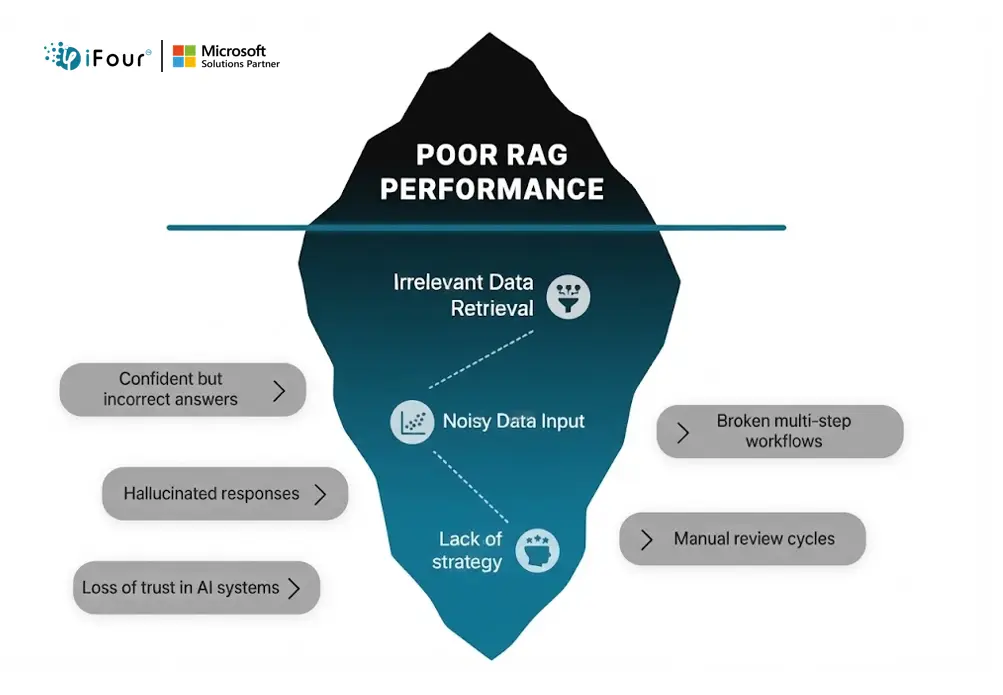
Poor Rag Performance

How Does Fabric Ontology Give AI Agents Business Context?

Fabric Ontology transforms disconnected enterprise information into a connected knowledge model, allowing digital assistants to understand business meaning instead of simply retrieving records.

1. Relationship Mapping

Fabric Ontology defines relationships between business entities.

Examples include:

  • Customer -> Contract
  • Contract -> Product
  • Product -> Revenue
  • Revenue -> Business Unit

These relationships allow smart agents to follow business logic more naturally.

Simplify complexity

Train AI on What Matters. Achieve it with our LLM Development & Consulting Services

2. Metadata Understanding

Metadata provides critical context. Examples:

  • Owner
  • Department
  • Classification
  • Sensitivity Labels
  • Data Lineage

With metadata, Cognitive agents can understand both information and its significance.

3. Shared Business Definitions

Different teams often define concepts differently. Ontology creates standardized definitions.

This consistency improves:

  • Reporting
  • Analytics
  • AI reasoning
  • Automation

4. Semantic Understanding

Traditional systems focus on values and fields. Ontology focuses on meaning.

This way, AI assistants can understand the real intent and context rather than simply matching keywords.

What Most Discussions Get Wrong About Agent Accuracy

A common assumption is:

More enterprise data automatically creates a more capable agent.

In practice, a larger pool of poorly described or weakly connected data can make retrieval noisier rather than more useful.

Retrieval-augmented generation, or RAG, gives an LLM access to information outside its training data by retrieving relevant material and placing it in the model's context. Microsoft's groundedness documentation describes RAG as a way to provide models with private or more recent information.

However, ordinary retrieval does not automatically encode domain relationships or business rules.

Accelerate growth

Build the backbone of intelligent agents with our MCP Server Development Services

Microsoft Research's OG-RAG work examines ontology-grounded retrieval for specialized domains. The research argues that conventional retrieval can generate suboptimal context when it does not account for structured domain knowledge. Its reported evaluation found improvements over the study's baseline methods, but those research results should not be presented as performance guarantees for Fabric Ontology or every enterprise implementation.

Fabric Ontology vs Traditional RAG: What Is the Difference?

Here is a detailed comparison between Traditional RAG and Fabric Ontology:

Traditional RAG Fabric Ontology
Retrieves data Understands data
Keyword-driven Relationship-driven
Limited business context Rich business semantics
Higher risk of hallucinations Better contextual grounding
Search-focused Understanding-focused

RAG helps agents find information. Ontology helps agents understand information.

To get more clarity, explore ontology-grounded RAG documentation for LLMs.

Does Fabric Ontology Eliminate Hallucinations?

No. Fabric Ontology can give agents better-defined entities, relationships, rules, and source mappings.

Microsoft says ontology-grounded agents can produce responses that are more grounded, explainable, and consistent than agents relying only on raw data or prompts.

However, output quality still depends on:

  • The accuracy and completeness of source data
  • The quality of the ontology design
  • Correct data bindings
  • Retrieval and query behavior
  • Agent instructions
  • Model limitations
  • Permissions and governance
  • Continuous testing and human review

A safer and more supportable claim is:

Fabric Ontology helps reduce semantic ambiguity and improve agent grounding. It does not guarantee factual accuracy or eliminate hallucinations. This is where human intervention is paramount to address AI hallucinations & bias.

To learn more about this, explore what AI hallucinations are.
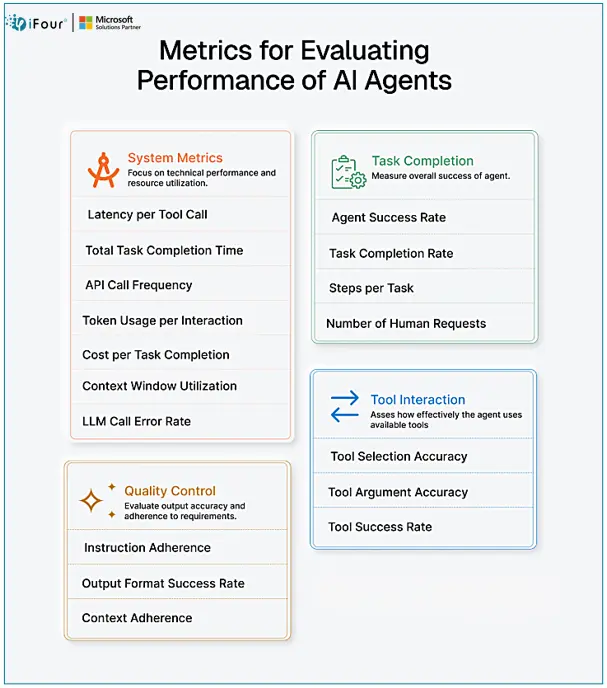
Metrics for AI Agent Evaluation

Business Benefits of Ontology-Grounded Agents

When you adopt ontology-grounded agents, you will observe the following benefits:

  • More consistent business interpretation: Agents can share definitions, rules, and metrics rather than relying on independently written prompts.

  • Better-grounded answers: Responses can use entity definitions, relationships, and bound enterprise information instead of depending only on raw tables or general model knowledge.

  • Greater explainability: Well-defined concepts and relationships can make it easier for users to understand and validate why information is connected.

  • Cross-domain reasoning: A shared vocabulary can support questions that span multiple business domains and OneLake sources.

  • Governed agent experiences: Ontology context can include data bindings, provenance, and access controls, helping agents work within the governed Fabric model.

Actionable solutions

Put routine tasks on autopilot. Do it with our Copilot Agent Consulting Services

Key Considerations Before Adopting Fabric Ontology

Fabric Ontology is currently a preview capability. Organizations should evaluate preview limitations, tenant requirements, governance needs, and production-readiness criteria before relying on it for critical workflows.

Microsoft's documentation also identifies current limitations. For example, ontology versioning and importing from Azure Synapse industry-specific database templates are not presently supported.

Companies should also plan for:

  • Vocabulary ownership
  • Domain-expert involvement
  • Source-data quality
  • Relationship validation
  • Permission design
  • Agent evaluation
  • Change management
  • Human oversight for consequential actions

So, to put it simply, the future of enterprise intelligence is built on context, not on models or raw language generations.

Ontology-Driven Agents: Key Things To Remember

  • AI agents can access business data without correctly understanding its meaning.
  • Context includes definitions, relationships, rules, metrics, provenance, permissions, and task-specific information.
  • RAG retrieves relevant evidence, while ontology defines structured business meaning.
  • Fabric Ontology is a preview capability within Fabric IQ, not a general-purpose guarantee against hallucinations.
  • It represents business concepts through entity types, properties, relationships, constraints, and data bindings.
  • Agents can use ontology context to produce responses that are more grounded, consistent, governed, and explainable.
  • Results still require accurate source data, careful ontology design, testing, security controls, and human review.

So that's all for this blog.

At iFour, we've seen many AI projects struggle, not because the technology failed, but because the foundation was missing. With extensive AI expertise, we helped clients across healthcare, fintech, and legal deal with this problem. If you are one looking for the same, contact us today.

Fabric Ontology for Enterprise AI - Summary

This blog has gone through the importance of key reasons why AI agents fail without context. Here's what we have learnt:

  • Why do AI agents fail?
  • What is context in AI agents?
  • What role does context play?
  • Importance of Microsoft Fabric for AI agents
  • How does Fabric Ontology work?
  • Reasons for AI hallucinations

After working with Azure AI implementations across industries, one thing becomes clear:

AI succeeds when it's built on trusted data, enriched with business context, guided by governance, and supported by human expertise.

The value of an enterprise agent depends not only on how much data it can access, but also on how reliably it can interpret that data in business terms.

Need assistance in turning your raw enterprise data into a shared business model? Get in touch with iFour, a leading Microsoft Fabric consulting company.

FAQs on Fabric Ontology for AI Agents:

1. What are the problems with AI Agents?

Some of the problems enterprises face are security risks, lack of control, and unpredictable reliability when performing multi-step workflows.

2. What's behind successful AI deployments?

Successful AI depends on quality data, business context, governance, and human oversight:

  • Quality Data - Accurate and trusted data.

  • Business Context - Clear rules and definitions.

  • Data Governance - Secure and controlled access.

  • Connected Systems - Unified business information.

  • Clear Goals - Defined use cases and outcomes.

  • Human Review - Ongoing validation and oversight.

  • Scalable Foundation - Ready for growth.

3. Why do most AI agents fail in production?

Enterprise Agents fail in production due to incomplete data layers, improper definitions, and loosely governed engineering systems.

4. Why is context engineering harder for AI agents?

Since LLMs have a finite context window, you can't feed them everything at once. The top reasons for context engineering failure in artificial intelligence are:

  • Agentic AI performs dynamic task execution
  • Unlike humans, AI agents can't remember past interactions naturally.
  • Accessing multiple AI tools creates a cognitive burden that makes things messy.
  • Poorly designed context in AI retrieves irrelevant information.
  • Too much context or too little context can lead to overwhelming or incomplete information.
Why AI Agents Fail Without Context (And How Fabric Ontology Fixes It) Quick Summary: AI agents don't fail because they lack intelligence. They fail because they lack business context. Enterprise data often contains information but not meaning. Fabric Ontology addresses this challenge by connecting data, business definitions, relationships, and semantics, helping AI agents understand how information relates across an organization. Note: Fabric Ontology makes AI responses more reliable, but human review is still needed for governance.   Enterprise AI agents are getting smarter every day. They can search data. Read documents. Call APIs. Use tools. Even complete multistep workflows on their own. Despite this, why do 90% of AI agents fail? Because Access to data DOESN'T mean understanding the business. The problem isn't capability. It's context. Now imagine this: Two AI agents have access to the same enterprise systems. One understands how business concepts, relationships, and rules connect. One doesn't. The first AI Copilot gives you answers that are consistent, explainable, and aligned with business reality. The second agent? It pulls information from disconnected sources, interprets concepts differently across systems, and sometimes returns answers nobody can confidently trust. That's the difference business context makes. Without a business context, even the most advanced AI agent can produce wrong and inconsistent answers. That's why organizations like iFour are turning to Microsoft Fabric Ontology to give AI agents a shared understanding of the business behind the data. Image: The key components of ontology-driven agents What is Fabric Ontology? It is a semantic framework from Microsoft that allows AI systems to understand business entities, relationships, metadata, and domain-specific meanings across enterprise data. Microsoft Fabric Ontology is a part of Fabric IQ, and it provides a machine-understandable representation of business concepts, such as products and customers, creating a shared vocabulary that AI assistants and Autonomous systems understand. Accuracy note: Fabric Ontology can improve grounding, consistency, and explainability, but it does not guarantee correct outputs or eliminate hallucinations.   What Does Context Mean for an Agent? Context is the business information that helps AI understand data correctly and make better decisions. It includes business rules, relationships, permissions, ownership, and other details that give meaning to raw data. For example, a customer generating $1.2 million in revenue is just a number. To understand what it means, AI may also need to know: Which revenue calculation is being used The time period covered Whether the customer account is active Related contracts and agreements Upcoming renewals Which business unit owns the account Whether the user has access to the underlying data An ontology provides this missing context. It organizes business entities, relationships, rules, and data connections into a shared structure that AI can understand. This helps AI deliver more accurate, consistent, and business-aware insights. Want to make your data AI-ready? Explore our Fabric Ontology development services that connect your data, business knowledge, and AI goals. Why AI Agents Fail Without Context? According to the 2025 Fortune report, 95% of companies faced enterprise AI failure due to learning gaps. The problem is not in model quality; the problem is a lack of context. AI agents struggle when they cannot understand business relationships, organizational structures, data lineage, or domain-specific definitions. That's where Fabric Ontology comes in to fill this gap by acting as a business context and semantic modeling layer. Enterprises, including Fortune 500s and SMEs, are investing heavily in intelligent systems to improve employee productivity, automate customer support, accelerate business operations, and accelerate AI-powered decision-making. The expectation is simple: Connect AI to enterprise data Ask questions Receive accurate answers Automate business processes But in reality, here's what they discover with autonomous systems: Conflicting responses Missing critical business nuances Inaccurate recommendations Enterprise-specific terminology problems Hallucinated information that sounds believable but isn't correct The issue usually isn't data access. The issue is context. Explore the full guide - AI Agents fail due to lack of context. Key Reasons AI Agents Fail AI doesn't fail because it's not intelligent enough. It fails when it lacks quality data, business context, governance, and human oversight. Let's walk through the major reasons why 80% of enterprise AI projects fail. 1. AI fails due to hallucinations Since the emergence of AI systems, everyone has started leaning towards AI for workflows, but the critical thing most people do is rely on AI answers blindly. AI is great at speed. But when AI doesn't get access to the right data, it starts producing hallucinated information, which could include: Fabricated answers Missing validation Wrong assumptions, etc. Since it is well-structured and confident, you feel the content is 100% correct. That's the problem. How does Ontology solve AI hallucinations? By giving AI the right business context, reducing wrong or made-up answers. Explore this to see what the context layer is and why it's become the most urgent problem in enterprise AI. Actionable solutions Outdated tools slowing your firm? Upgrade fast with our Legal Software Development services Get Started Now Reach Out via LinkedIn 2. Misinterpreting business language causes AI failure A common word in business could have different meanings. For example: "Revenue" "Net Revenue" "Booked Revenue" So, autonomous agents could misinterpret these words and cause AI Agent failure. How does Microsoft Ontology solve this? By defining business terms clearly to make AI understand them the same way humans do. 3. Connecting disconnected data could cause AI agent failure Your data might be stored in multiple locations. It could be anywhere like CRM, ERP, Finance systems, SaaS systems, or SharePoint where permissions are paramount for accessibility. This is where real business context gets lost, causing enterprise artificial intelligence failure. Data exists separately. Business meaning is lost. How does ontology solve this? By linking data across systems, you give AI a complete business view. Read More: How to Build AI Agents: Strategic Guide for CTOs 4. AI produces different answers for similar questions. You've probably noticed that if you ask an AI the same question multiple times, you'll see different answers each time. This creates problems in your decision-making, which then causes real issues. Let's understand, with an example, how an AI agent gets the wrong answer. Suppose you are a sales manager, and you ask your Agentic AI: "Which customers are at the highest risk of churn?" Without context: Agent checks support tickets only. Misses sales engagement. Misses contract renewal dates. The Result? Intelligent chatbots give you wrong recommendations confidently which then impact your decision-making. The key takeaway here is: “Data access alone doesn't create business understanding. Conversational AI requires semantic context.” How does ontology help in this case? Using consistent definitions and rules, ontology helps Copilot AI give consistent answers. How Does Fabric Ontology Give AI Agents Business Context? Fabric Ontology transforms disconnected enterprise information into a connected knowledge model, allowing digital assistants to understand business meaning instead of simply retrieving records. 1. Relationship Mapping Fabric Ontology defines relationships between business entities. Examples include: Customer -> Contract Contract -> Product Product -> Revenue Revenue -> Business Unit These relationships allow smart agents to follow business logic more naturally. Simplify complexity Train AI on What Matters. Achieve it with our LLM Development & Consulting Services Get Started Now Let's Talk on LinkedIn 2. Metadata Understanding Metadata provides critical context. Examples: Owner Department Classification Sensitivity Labels Data Lineage With metadata, Cognitive agents can understand both information and its significance. 3. Shared Business Definitions Different teams often define concepts differently. Ontology creates standardized definitions. This consistency improves: Reporting Analytics AI reasoning Automation Read More: AAgentic AI Use Cases, Examples & Success Stories | Real-World Business Impact 4. Semantic Understanding Traditional systems focus on values and fields. Ontology focuses on meaning. This way, AI assistants can understand the real intent and context rather than simply matching keywords. What Most Discussions Get Wrong About Agent Accuracy A common assumption is: More enterprise data automatically creates a more capable agent. In practice, a larger pool of poorly described or weakly connected data can make retrieval noisier rather than more useful. Retrieval-augmented generation, or RAG, gives an LLM access to information outside its training data by retrieving relevant material and placing it in the model's context. Microsoft's groundedness documentation describes RAG as a way to provide models with private or more recent information. However, ordinary retrieval does not automatically encode domain relationships or business rules. Accelerate growth Build the backbone of intelligent agents with our MCP Server Development Services Get Started Now Let's Talk on LinkedIn Microsoft Research's OG-RAG work examines ontology-grounded retrieval for specialized domains. The research argues that conventional retrieval can generate suboptimal context when it does not account for structured domain knowledge. Its reported evaluation found improvements over the study's baseline methods, but those research results should not be presented as performance guarantees for Fabric Ontology or every enterprise implementation. Fabric Ontology vs Traditional RAG: What Is the Difference? Here is a detailed comparison between Traditional RAG and Fabric Ontology: Traditional RAG Fabric Ontology Retrieves data Understands data Keyword-driven Relationship-driven Limited business context Rich business semantics Higher risk of hallucinations Better contextual grounding Search-focused Understanding-focused RAG helps agents find information. Ontology helps agents understand information. To get more clarity, explore ontology-grounded RAG documentation for LLMs. Read More: AI + Excel: The Automation Development for Commodity Intelligence Does Fabric Ontology Eliminate Hallucinations? No. Fabric Ontology can give agents better-defined entities, relationships, rules, and source mappings. Microsoft says ontology-grounded agents can produce responses that are more grounded, explainable, and consistent than agents relying only on raw data or prompts. However, output quality still depends on: The accuracy and completeness of source data The quality of the ontology design Correct data bindings Retrieval and query behavior Agent instructions Model limitations Permissions and governance Continuous testing and human review A safer and more supportable claim is: Fabric Ontology helps reduce semantic ambiguity and improve agent grounding. It does not guarantee factual accuracy or eliminate hallucinations. This is where human intervention is paramount to address AI hallucinations & bias. To learn more about this, explore what AI hallucinations are. Business Benefits of Ontology-Grounded Agents When you adopt ontology-grounded agents, you will observe the following benefits: More consistent business interpretation: Agents can share definitions, rules, and metrics rather than relying on independently written prompts. Better-grounded answers: Responses can use entity definitions, relationships, and bound enterprise information instead of depending only on raw tables or general model knowledge. Greater explainability: Well-defined concepts and relationships can make it easier for users to understand and validate why information is connected. Cross-domain reasoning: A shared vocabulary can support questions that span multiple business domains and OneLake sources. Governed agent experiences: Ontology context can include data bindings, provenance, and access controls, helping agents work within the governed Fabric model. Actionable solutions Put routine tasks on autopilot. Do it with our Copilot Agent Consulting Services Get Started Now Let's Talk on LinkedIn Key Considerations Before Adopting Fabric Ontology Fabric Ontology is currently a preview capability. Organizations should evaluate preview limitations, tenant requirements, governance needs, and production-readiness criteria before relying on it for critical workflows. Microsoft's documentation also identifies current limitations. For example, ontology versioning and importing from Azure Synapse industry-specific database templates are not presently supported. Companies should also plan for: Vocabulary ownership Domain-expert involvement Source-data quality Relationship validation Permission design Agent evaluation Change management Human oversight for consequential actions So, to put it simply, the future of enterprise intelligence is built on context, not on models or raw language generations. Read More: AI in Power BI - Top Use cases and Best Practices Ontology-Driven Agents: Key Things To Remember AI agents can access business data without correctly understanding its meaning. Context includes definitions, relationships, rules, metrics, provenance, permissions, and task-specific information. RAG retrieves relevant evidence, while ontology defines structured business meaning. Fabric Ontology is a preview capability within Fabric IQ, not a general-purpose guarantee against hallucinations. It represents business concepts through entity types, properties, relationships, constraints, and data bindings. Agents can use ontology context to produce responses that are more grounded, consistent, governed, and explainable. Results still require accurate source data, careful ontology design, testing, security controls, and human review. So that's all for this blog. At iFour, we've seen many AI projects struggle, not because the technology failed, but because the foundation was missing. With extensive AI expertise, we helped clients across healthcare, fintech, and legal deal with this problem. If you are one looking for the same, contact us today. Fabric Ontology for Enterprise AI - Summary This blog has gone through the importance of key reasons why AI agents fail without context. Here's what we have learnt: Why do AI agents fail? What is context in AI agents? What role does context play? Importance of Microsoft Fabric for AI agents How does Fabric Ontology work? Reasons for AI hallucinations After working with Azure AI implementations across industries, one thing becomes clear: AI succeeds when it's built on trusted data, enriched with business context, guided by governance, and supported by human expertise. The value of an enterprise agent depends not only on how much data it can access, but also on how reliably it can interpret that data in business terms. Need assistance in turning your raw enterprise data into a shared business model? Get in touch with iFour, a leading Microsoft Fabric consulting company. FAQs on Fabric Ontology for AI Agents: 1. What are the problems with AI Agents? Some of the problems enterprises face are security risks, lack of control, and unpredictable reliability when performing multi-step workflows. 2. What's behind successful AI deployments? Successful AI depends on quality data, business context, governance, and human oversight: Quality Data - Accurate and trusted data. Business Context - Clear rules and definitions. Data Governance - Secure and controlled access. Connected Systems - Unified business information. Clear Goals - Defined use cases and outcomes. Human Review - Ongoing validation and oversight. Scalable Foundation - Ready for growth. 3. Why do most AI agents fail in production? Enterprise Agents fail in production due to incomplete data layers, improper definitions, and loosely governed engineering systems. 4. Why is context engineering harder for AI agents? Since LLMs have a finite context window, you can't feed them everything at once. The top reasons for context engineering failure in artificial intelligence are: Agentic AI performs dynamic task execution Unlike humans, AI agents can't remember past interactions naturally. Accessing multiple AI tools creates a cognitive burden that makes things messy. Poorly designed context in AI retrieves irrelevant information. Too much context or too little context can lead to overwhelming or incomplete information.
Kapil Panchal

Kapil Panchal

A passionate Technical writer and an SEO freak working as a Content Development Manager at iFour Technolab, USA. With extensive experience in IT, Services, and Product sectors, I relish writing about Azure Cloud, Data Analytics, AI, & Workflow Automation and love sharing exceptional insights on various platforms. I believe in constant learning and am passionate about being better every day.


Build Your Agile Team

Categories

Ensure your sustainable growth with our team

Talk to our experts
Sustainable
Sustainable
 
Blog Our insights
How to Build AI Agents: Strategic Guide for CTOs

31 March 2026

Kapil Panchal

How to Build AI Agents: Strategic Guide for CTOs

AI agents are everywhere these days. The world's biggest tech players - Microsoft, Alphabet, Amazon, and Meta are investing heavily in AI infrastructure, with spending expected...
Ethical AI in Healthcare: Key Considerations For Patient Safety

03 February 2026

Kapil Panchal

Ethical AI in Healthcare: Key Considerations For Patient Safety

Let’s keep it simple. In healthcare, trust, safety, and human dignity come first, no matter what solution you build. The same applies to AI. Today, it is everywhere, from clinics...

Agentic AI Use Cases, Examples & Success Stories | Real-World Business Impact

02 January 2026

Kapil Panchal

Agentic AI Use Cases, Examples & Success Stories | Real-World Business Impact

Let's keep it real. The whole point of building autonomous Agents is to cut manual work and keep focus on business. Approvals that used to take days can happen in hours because...