How Can CTOs Implement AI Agents (Strategic Roadmap)
Before you start building an AI Agent, make sure your purpose and requirements are clear. Because, as a CTO, your responsibility is not just to “use AI,” but to architect scalable, secure, production-ready intelligent systems that deliver measurable business outcomes. In short, considering principles of building AI agents is essential.
Here's the checklist you can follow for building AI Agents:
- Define a clear business objective
- Choose the right architecture
- Implement RAG if required
- Add memory & tool orchestration
- Establish governance
- Design evaluation metrics
- Plan the scalability
CTOs searching “ How to build an AI agent?” typically want the following aspects:
1. A structured, production-ready roadmap
2. Architectural clarity
3. Technology stack decisions
4. Governance & security considerations
5. Scalability guidance
6. Cost vs ROI clarity
So, here's the step-by-step structure to build an AI Agent for CTOs
Step 1: Define the Business Objective (Not the Model)
Before selecting a large language model (LLM) or AI framework, clarify:
- What problem does the AI agent solve?
- Is it automating tasks, augmenting humans, or replacing manual workflows?
- What KPIs define success? (Accuracy, response time, cost reduction, revenue impact)
Example Enterprise Use Cases of Agentic AI
- AI customer support agent
- Internal knowledge assistant
- AI sales copilot
- Healthcare triage agent
- Financial risk monitoring agent
- DevOps automation agent
Your AI architecture should be problem-first, not model-first.
Step 2: Choose the Right AI Agent Architecture
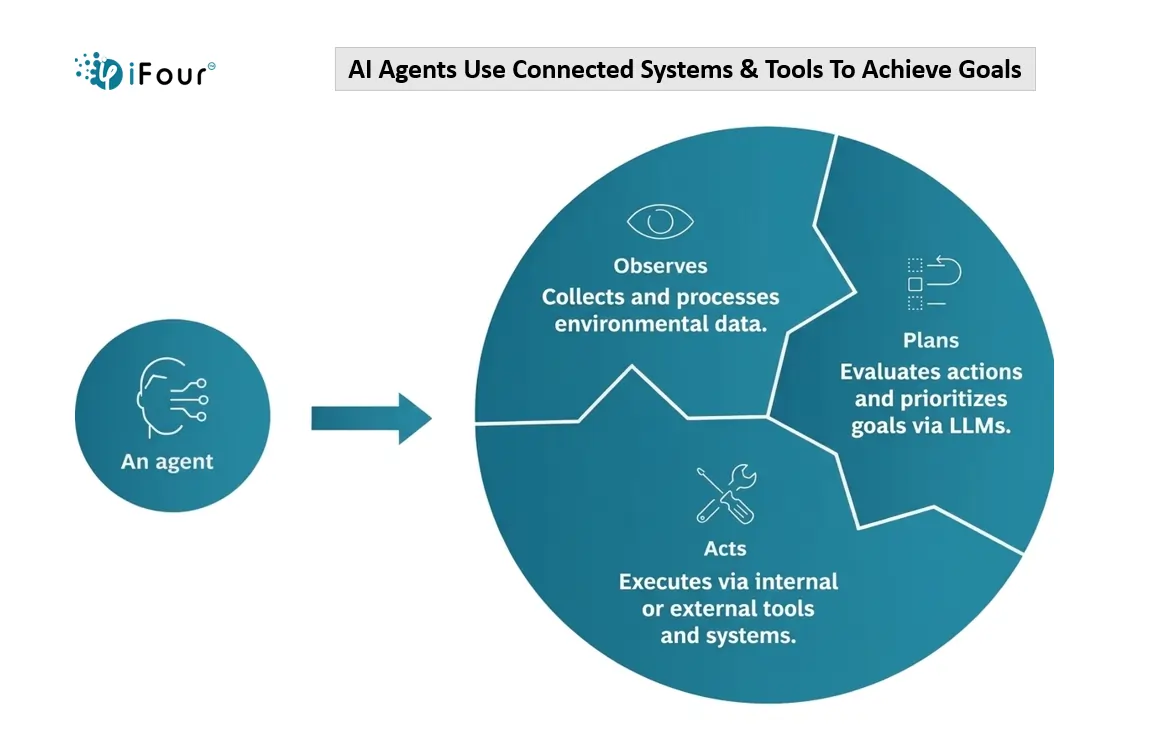
AI agents typically follow one of these architectures:
1. Reactive Agents
2. Memory-Enabled Agents
3. Tool-Using Agents
4. Multi-Agent Systems
Step 3: Design the Core AI Agent Components
A production-ready AI agent includes the following layers:
1. Input Layer
-
User interface (chat, API, dashboard)
-
Event streams
-
Structured/unstructured data
2. Intelligence Layer
3. Memory Layer
-
Vector database
-
Session memory
-
Long-term knowledge base
4. Tool & Action Layer
-
REST APIs
-
Databases
-
CRM / ERP integrations
-
Workflow engines
5. Governance & Monitoring Layer
Enterprise AI agents fail when governance is ignored.
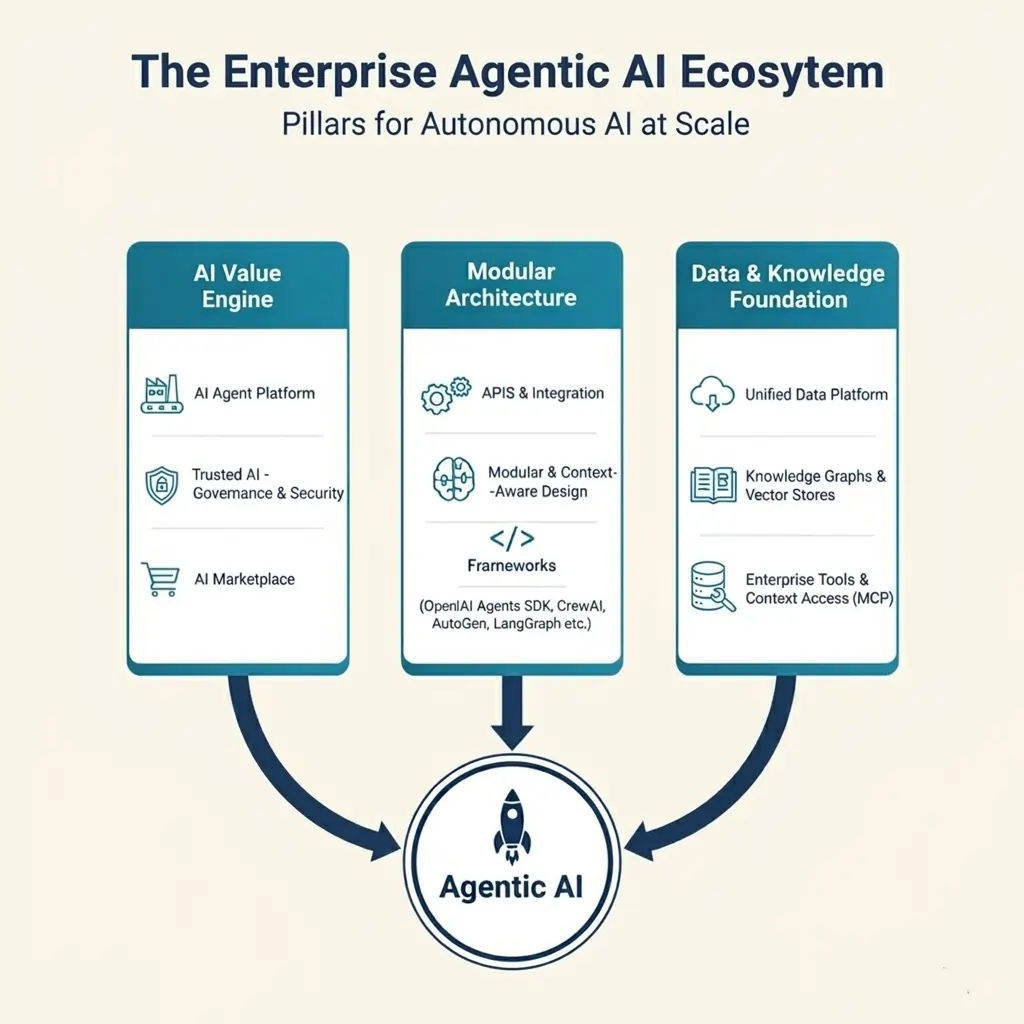
Step 4: Select the Technology Stack
I have published blog on PlusRadiology Site
AI Models
- Open-source LLMs
- Commercial LLM APIs
- Fine-tuned models
Frameworks for AI Agents
- LangChain
- Semantic Kernel
- AutoGen
- CrewAI
Infrastructure
- Cloud-native architecture
- Kubernetes orchestration
- Serverless compute
- GPU-based inference endpoints
Data Layer
- Vector databases
- Data lakes
- Knowledge graphs
For CTOs, stack selection must balance:
- Performance
- Cost
- Vendor lock-in risk
- Security
- Compliance
Step 5: Implement Retrieval-Augmented Generation (RAG)
If your AI agent needs domain-specific knowledge, RAG is essential.
RAG architecture includes:
1. Document ingestion pipeline
2. Embedding generation
3. Vector search
4. Context injection into LLM prompt
RAG improves:
- Factual accuracy
- Domain alignment
- Reduced hallucinations
- Data security
Without RAG, enterprise AI agents often provide generic answers.
Step 6: Establish Guardrails & AI Governance
AI governance is not optional. As a CTO, you must implement:
- Role-based access control
- Data encryption
- Prompt injection protection
- Toxicity filters
- Bias monitoring
- Audit trails
Consider regulatory compliance, such as:
Trust and explainability drive adoption.
Step 7: Test, Evaluate, and Optimize
AI agents require structured evaluation.
Testing Framework
- Unit testing for tool execution
- LLM response benchmarking
- Latency monitoring
- Hallucination rate analysis
- User feedback loop
Evaluation Metrics
- Task completion rate
- Accuracy score
- User satisfaction
- Cost per request
- Response time
Continuous optimization is mandatory.
Step 8: Deployment & Scaling Strategy
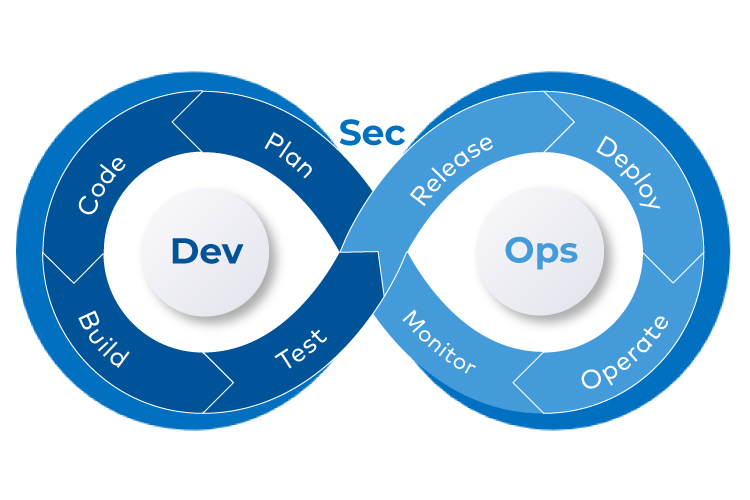
AI agent deployment should follow DevOps best practices:
- CI/CD pipelines
- Canary releases
- API rate limiting
- Horizontal scaling
- Observability dashboards
Plan for:
- Traffic spikes
- Model updates
- Versioning
- Failover mechanisms
Production AI systems must be resilient.
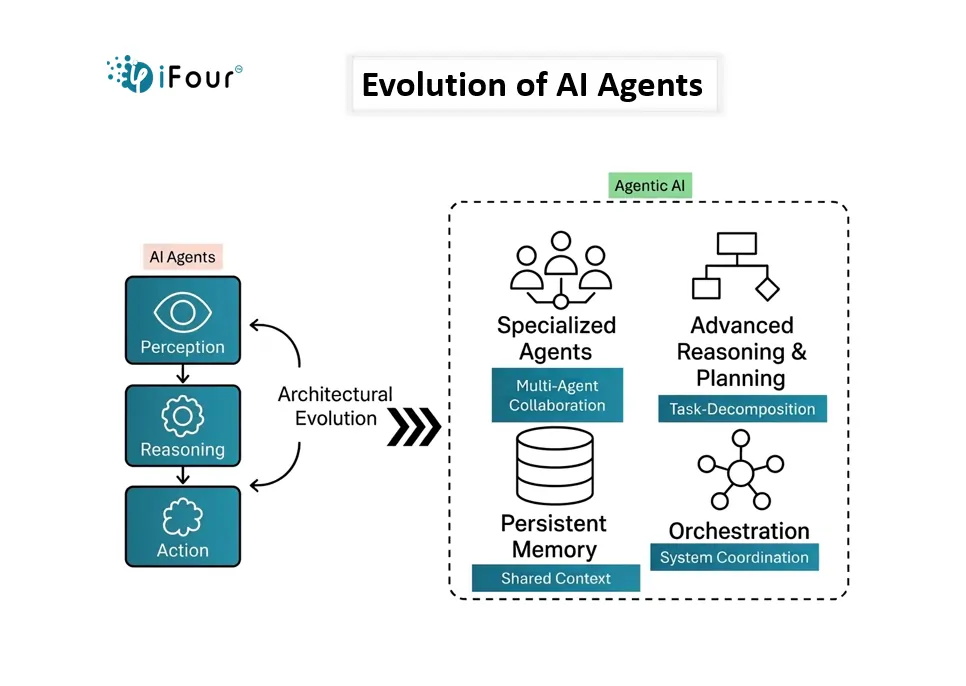
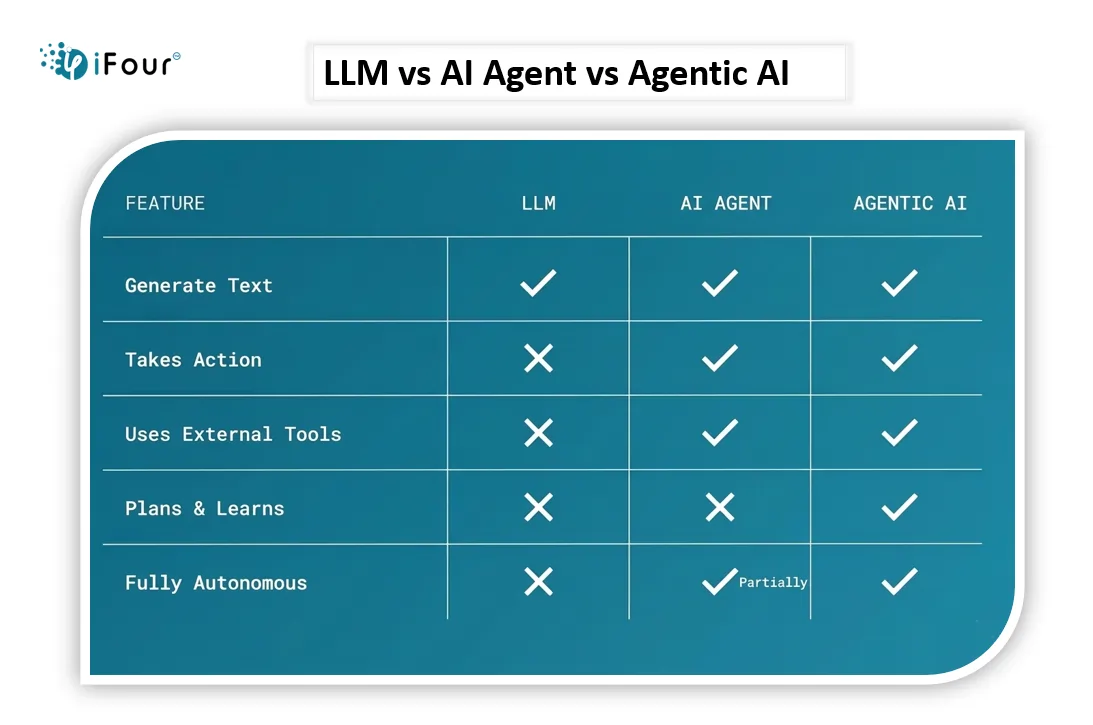
Meanwhile, check out the key differences between LLM, AI Agent, and Agentic AI in the following image.