


















































What’s New in ASP.NET Core 10 – Key Features & Expert Insights
We tracked the evolution of .NET 9 on Reddit, and watched the heated debates on .NET 6 vs .NET 8. And just when we thought that things had finally settled, Microsoft drops another...


601 & 612, The Times square Arcade, Near Baghban party plot, Thaltej - Shilaj Road, Thaltej, Ahmedabad, Gujarat - 380059
Listening is fun too.
Straighten your back and cherish with coffee - PLAY !
The current digital era has compelled businesses to make their online presence through various sources like websites, web applications, or mobile apps and form brand visibility. It has pushed them to the point where they must maintain active connections with their customers to stay competitive in the market.
The prospect of developing a new website or app could be exciting, but it also brings with it a slew of problems for organizations while choosing the right technology, tools, languages, and other factors to cover their needs.
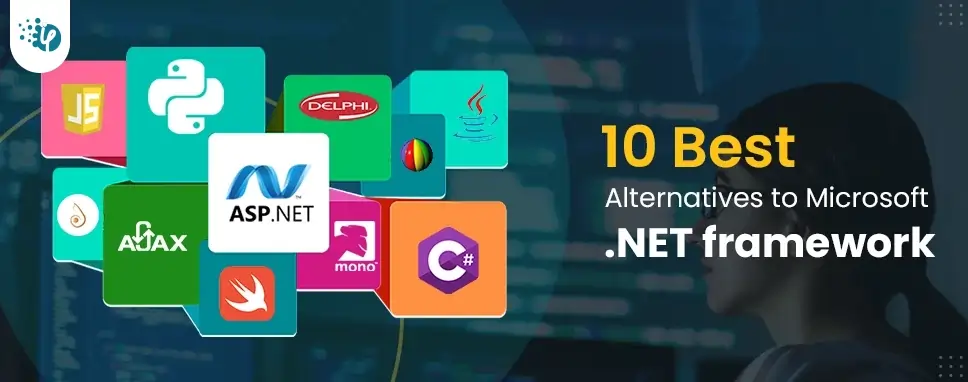
Microsoft .NET framework is an amazing option for the clients to go with. However, it is also important to understand the best alternatives to get rid of dependency. In this blog, we will learn the ten best alternatives for the Microsoft .NET framework.
Spring Boot is an open-source Java framework used for web application development, enterprise software, and microservices. It simplifies application development with built-in configurations, embedded servers, and seamless integration with databases and REST APIs. Its scalable architecture, cloud-ready capabilities, and strong community support make it a popular choice for building secure, high-performance backend applications with less development effort.
- Brian Dean, Founder of Exploding Topics
NestJS is a modern Node.js framework built with TypeScript for developing scalable server-side applications. It supports REST APIs, GraphQL, and microservices while providing a modular architecture that makes applications easier to build and maintain. NestJS is widely used for backend development because it offers better code organization, high scalability, and faster application development for enterprise projects.
- Herbert Riggs, CEO of UnscrambleX
FastAPI is a modern Python framework designed for building high-performance REST APIs and web applications. It is widely used in AI, machine learning, cloud applications, and backend development due to its speed and automatic API documentation. FastAPI also supports asynchronous programming and data validation, helping developers build secure, scalable, and reliable APIs with less code.
- Eric Carrell, Marketing Advisor of SurfShark
“Without additional context to clarify the question, the best alternative to the .NET framework (version 5) would be Java or one of the other Java Virtual Machine (JVM) languages (Scala, Groovy, Kotlin, Jython, etc).
This is because the .NET framework offers the capability to write any sort of application (web, desktop, CLI, etc) and have it run the same on any platform where its underlying runtime, the CLR, is available. Likewise, Java and the other JVM languages offer the same capability anywhere the JVM is available.”
- Rich Moulton from Red Alpha LLC
“In my opinion, the best alternative to the .NET framework is Delphi. It is super-fast and is constantly being developed so you know it is going to stay on the curve. It is compatible with operations of the .NET framework so it is an easy transition.”
- Brian Donovan, CEO of Timeshatter

“Python is one of the most powerful programming languages since it can be used for diverse purposes. You can use it for website development, software prototypes, data science, and many other functions. Moreover, its syntax is easy to use, making it the ideal language for beginners.”
- Katherine Brown, Founder & Marketing Director of Spyic
“The Right Key Is in C#: So far, one of the key alternatives out there for .NET happens to be C#. This happens to be due to the C# language maintaining a lot of the features which were missing or underwhelming in the .NET framework. C# has been able to provide updates to its host of code over the years and has supported developers quite well, along with providing the right cross-platforming which allows it to also play well with other languages.”
- Carla Diaz, Co-founder of Broadband Search
“If you have a small team and need to build Web apps as part of your offering, then node can be a great alternative strategically for your team. We were able to do far more than otherwise possible for our clients when our team was small because we embraced Javascript on the front and backend; it allowed us to build Web Apps (React), Mobile Apps (React Native), and APIs (Node) with one small team. In addition, Javascript allows you to share code, but even if you choose not to, being able to share developers is invaluable. We consider this to be one of our 4 pillars of predictable, affordable development, which include being smart about the team, tools, process, and features. By choosing Javascript we can get way more out of smaller teams.
If you are building a web app, Javascript will be unavoidable in your stack, so you will have to hire Javascript developers. Using the same language on the backend makes it so everyone can be a full-stack developer. We've had very few challenges with this approach and great outcomes. And if you use React on the front end and your mobile app lines up with the React Native use cases (we've found that most do), you can have your team take on mobile development too.
You might be hesitant to use this approach because the skills that differentiate FE (CSS) and BE (entity modeling, transactions, etc...) could be viewed as a problem; you might be thinking you'd need to hire unicorns. However, we've handled this situation pretty easily by having one strong dev from each camp available to mentor and/or do those tasks and making sure we are following good development practices like code reviews and pair programming. For HTML/CSS layout, we have a dedicated engineer who provides the team with HTML and CSS, so all the devs have to do is wire up the behavior and async calls, allowing us to not have every developer be a CSS wizard (and let's be real, CSS is kind of a mystic art).”
- Ryan Vice, Co-founder and CEO of Vice Software

Go, also known as Golang, is an open-source programming language used for backend development, cloud applications, and distributed systems. Frameworks like Gin and Fiber make it easier to build fast web applications and REST APIs. With its simple syntax, excellent concurrency support, and high performance, Go is a preferred choice for developing scalable and resource-efficient applications.
- Lynda Fairly, Co-founder of Numlooker
Laravel is a popular PHP framework used for web application development, enterprise websites, and eCommerce solutions. It follows the MVC architecture and includes built-in features for authentication, routing, database management, and security. Laravel helps developers build secure, scalable, and feature-rich web applications faster, making it one of the most widely used PHP frameworks.
- Shiv Gupta, Marketing Director of Incrementors Web Solutions
“Java, Delphi, Mono, and ASP.NET are the best alternatives to the .NET framework.
Java is one of the general-purpose computer programming languages, which is class-oriented, concurrent, object-based, and specially designed to possess a fewer implementation dependency.
Delphi is the best alternative to get the safest future, high performance, .NET compatibility, well documentation, and so on.
On the other hand, mono is also an outdated open-source implementation of .NET, which is more vibrant, and it's easy to operate C# code on iOS, Android, and other platforms.
The last alternative to the .NET is ASP.NET, which is an open-source for web server development on Windows. Therefore, it is also the best alternative to the outdated .NET framework, which can work seamlessly.”
- Eden Cheng, Co-Founder of PeopleFinderFree
“ASP.NET
This framework is open source which comes with obvious advantages plus it's easy to use.
Java
This is a framework already very popular as far as usage, plus it has a bunch of available libraries, and it features excellent tools as well.
Python
Python is object-oriented which is a plus, its code is easily readable, and it’s open-source as well. It's also fast which is another benefit.”
- Thomas Hawkins, Owner of Electrician Apprentice HQ
It is no surprise that Microsoft .NET is a leading framework and a stiff competitor in the market. However, it is also important to comprehend the best alternatives for the clients to avoid dependency. Through this blog, you would learn what are the best alternatives to the .NET framework and what features make them differ from it.

A passionate Technical writer and an SEO freak working as a Content Development Manager at iFour Technolab, USA. With extensive experience in IT, Services, and Product sectors, I relish writing about Azure Cloud, Data Analytics, AI, & Workflow Automation and love sharing exceptional insights on various platforms. I believe in constant learning and am passionate about being better every day.


Build Your Agile Team
Recent Posts

Top AI Frameworks Recommended on Reddit For Enterprise Use
October 19, 2026

AI in Legal Practice: Powerful Use Cases Every Lawyer Should Know
September 10, 2026

How to Use Power BI for Sales Forecasting (Guide for CTOs)
August 06, 2026

AI in Power BI - Top Use cases and Best Practices
August 03, 2026
Categories

We tracked the evolution of .NET 9 on Reddit, and watched the heated debates on .NET 6 vs .NET 8. And just when we thought that things had finally settled, Microsoft drops another...
Today, we’re thrilled to present you with the first glimpse of .NET 9 release and let you know what features and updates you can anticipate in this new version. Various professionals believe that it’s the right time to explore and adopt the latest version of .NET for your upcoming projects. It is even recommended for projects built using .NET 6 or .NET 8, due to the framework updates made in this version.
Several experts, particularly those just starting out, often find themselves confused about WPF and UWP, wondering if they are the same. Since they are used to create great UIs for...

Get this Demo!
Get this Demo!
Get this Demo!
Get this Demo!
Get this Demo!
Get this Demo!